We often hear the term “live large.” But what does it mean to “live small”?
Professor Reginald Ray offers a good description in his book Indestructible Truth. In writing about motivation or the intention with which we pursue various activities in life he says:
“The small level of ordinary motivation refers to beings whose focus in life is on being happy and content within their one lifetime, trying to make themselves secure and comfortable. They seek a good family situation, health, an ample income, a fine dwelling, social status, and so on. They . . . are not concerned with what happened before . . . or what will happen later.” (Ray, 314)
It seems to me that to live a middle class lifestyle without any concern about how that lifestyle exploits or impoverishes others is truly a very small life. It is difficult to learn how many ordinary things we do affect others around the globe. But it is necessary in living an examined life.
Our deepest fear is not that we are inadequate. Our deepest fear is that we are powerful beyond measure. It is our light, not our darkness that most frightens us.
We ask ourselves, Who am I to be brilliant, gorgeous, talented, fabulous? Actually, who are you not to be?
You are a child of God. Your playing small does not serve the world. There is nothing enlightened about shrinking so that other people won’t feel insecure around you.
We are all meant to shine, as children do. We were born to make manifest the glory of God that is within us. It’s not just in some of us; it’s in everyone.
And as we let our own light shine, we unconsciously give other people permission to do the same.
As we are liberated from our own fear, our presence automatically liberates others.
My one life is a very valuable gift. Living small devalues that gift.
Imagine taking a walk with God. This presentation will inspire and uplift you. God lives in the deepest part of our being. We can walk with God anytime we connect with our true self.
If you are interested in different ways of imagining God watch the film Quantum Activist with physicist Amit Goswami (Netflix Play Instantly), read John Haught’s 101 Questions On God and Evolution, the best selling novel The Shack or simply read the bible.
In the bible, God is portrayed as an architect and potter in Genesis, a cloud of smoke and a pillar of fire in Exodus, even a burning bush. In the gospels, Jesus uses over 39 images for God including God as a woman with a lost coin, God as water that sustains us, and God as a vine.
In her book Models of God, theologian Sallie McFague presents us with the rich images of God as a mother, a lover and a friend. These images place God directly into the deepest and most intimate relationships we will ever have. While these images may be new for some, they are actually quite old. She has pulled these images directly from the bible. In the Book of Hosea, God is described as our mother and as Job’s friend in the Book of Job. An entire book of the bible is devoted to describing God as a lover – the Song of Songs.
What are your images of God? What new ones could you add?
Our U.S., single-family-home lifestyle is not the only choice we have. In other times and places people figured out other ways to live peacefully, thoughtfully and in harmony with each other and with the land.
This is important to consider in light of the foreclosure crisis, the medical insurance crisis, and rising unemployment and homelessness among families.
We do have other options for living comfortably, collaboratively and ecologically. Unrelated families can live together sharing one large home for example. Younger students can live with older, retired persons allowing the abilities and interractions of both to enrich everyone. Young adults may share a home and pool their resources allowing one or more to finish their education while the others work – then reciprocate the next year in an intentional living arrangement.
In centuries past, the Beguines were a group of Catholic women who figured out how to share and collaborate with work and living arrangements while allowing each woman her own space. This is a model that might be useful with our aging population today.
Here’s an exerpt from a fascinating article in Commonweal on Modern Day Beguines. Read the full article in the May 22, 2009 issue of Commonweal entitled “Simple Lives A NEW BEGINNING FOR THE BEGUINES?” by Jean Hughes Raber.
“Recent news stories highlighting a growing trend among single women to form intentional communities along spiritual or religious lines make one wonder: Are we seeing the rise of a third wave of the Beguines, a Catholic women’s movement that started in the late twelfth century?”
“There [are] many parallels between the Beguines then and women now-women building safety nets to assist each other, living lives that made sense with less economic burden on the individual, a common spiritual approach to everyday life, and the need for meaningful, purposeful work,” says Morgana Morgaine, a nurse in Asheville, North Carolina, who has studied the Beguines for the past twenty-five years and, with five other women, plans to create a Beguine-inspired community.
Morgaine is not alone. She hopes to tour medieval beguinages in Europe and to meet modern-day Beguines in Germany, who live in an estimated twenty-five communities accommodating retirees, widows, divorcees, and single mothers. Many of the women work outside the community at day jobs, share housekeeping duties, and perform charitable works such as volunteering in hospices, tutoring children, and sheltering victims of domestic violence. Like their medieval counterparts, they agree to live simply, and this includes not only curbing consumption but choosing “green” and fair-trade products.
Morgaine first heard about the Beguines in an Albuquerque quilt shop twenty-five years ago: “I somehow got into a conversation about [how] living communally made so much sense economically and socially. I was talking about the wasted energy and monies of supporting a single household and the joys of sharing lawn mowers and laundry, and having more people to support and be supported by.” It turns out the shopkeeper had lived in Belgium, one of the great medieval Beguine centers, and recommended that Morgaine look into their history.
. . . Just as they responded so nimbly to social and economic forces in the twelfth century, the Beguines may offer a model well suited to the twenty-first. Again there are large numbers of single women facing life alone. Jobs are tight for younger women, and the costs of child care and fuel eat up a frighteningly large portion of their incomes. Baby Boom women approaching retirement are finding that their IRAs and 401(k)s won’t stretch as far as they’d hoped-and equity in their homes, another source of retirement income, is dwindling after the housing bust. Reductions in Medicare and the constant specter of Social Security cuts add to the economic uncertainty. And as women try to help elderly parents struggling to maintain the family home that has become burdensome and isolating, a communal living arrangement seems more sensible, economically and socially.
But those aren’t the only reasons the Beguines look attractive now. The beguinage fed body and spirit, and today’s Beguines also want a robust spiritual life. What has changed in the intervening centuries, however, is that those who call themselves Beguines today are not strictly Catholic, but include Protestants and sometimes non-Christians. Beguine communities now, as in the Middle Ages, must develop worship that will accommodate all their members. A California group calling itself the American Beguines follows the tradition of Taizé. Morgaine’s group in Asheville also wants a common spiritual space but has not yet worked out any specific devotional practice.
Despite the ecumenism of third-wave Beguine communities, the Beguine movement remains, at its core, essentially Catholic, emphasizing worship, the works of mercy, simplicity, and antimaterialism. In a way, the first-wave Beguines have lived on as missionaries across the centuries, inspiring women today to uphold the dignity of women and encouraging them to respond to economic challenges with faith, hope, and courage.
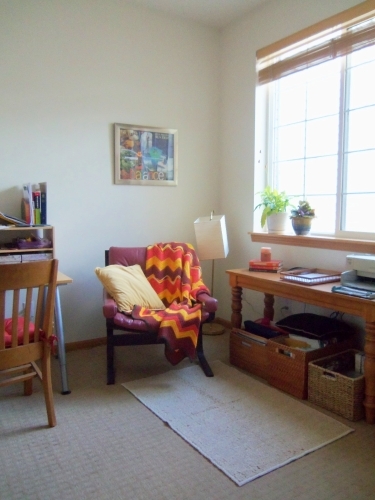
What’s more American than the front porch? You may remember that I thought it would be nice to have a porch on the front of our townhouse. Well, we don’t have a front porch, but we do have a room that faces east at the front of our townhouse. It also has a large window that brings the outside in – much like a sunroom.
While it serves as an office, it would be nice to use it more often. It could be an afternoon reading space, a morning coffee space or an evening tea space.
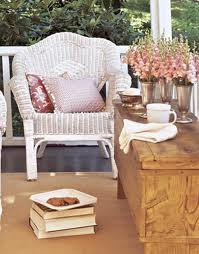
Here’s my inspiration photo.
Photo CountryLiving.com
What do I like about this porch? The chair and table are the only furniture. It’s simple. It’s relaxed. There’s not too much here. Flowers add a summery feel. I like the white and honey-color wood.
Giving our room a “sun room” feel will encourage us to use it more often – perhaps for evening tea in the summer or for morning coffee in the winter. Lighter, brighter, more casual decor will be the enticement. Again, I want to use items I already have.
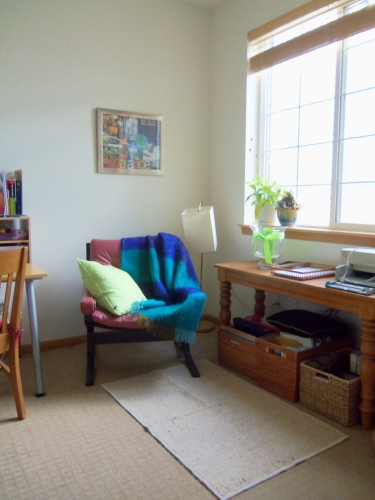
I’ll only use what we already have. First a comfortable chair, side table and lamp for evening use. Next add a plant or two, a pillow & cotton throw in bright colors.
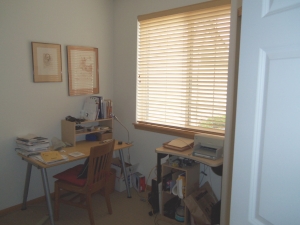
Before
After with cool summer colors –
Photo R. Meshar
After with warm autumn colors –
Photo R. Meshar
It’s coming along. Wicker baskets we had went a long way to organizing the office supplies. The pine table and green plants (moved from the living room) add warm color and life. The chair (my favorite and really comfortable) and lamp make a nice reading spot and the cotton rug feels good underfoot.
It still needs something on the wall above the desk, however. We’ll have to see what goes there . . .
Meanwhile, it’s brighter, more inviting. It’s a nice coffee spot. We’ve already been using this space more often.
Fall is approaching. A good time to assess my front hall closet. How many coats and jackets do I really need? How much is enough?
Currently I have four coats & jackets that you can see here in the photo on the left. I have a white denim jacket, not shown here – so really five coats/jackets. I am checking resale shops for one mid-length, hooded jacket with a lining that could be used as both a raincoat, lightweight jacket and warmer jacket. Then I could donate my both the lightweight jacket and the raincoat.
In addition I have 2 pairs of winter boots and assorted gloves, mittens and scarves. How much is enough when so many have nothing? How much is too much?