
Poverty is a Luxury We CanNOT Afford

In this time of the Great Recession, if we are cutting budgets, saving more and using our brains, we should be realizing that poverty is expensive. In fact it’s way too expensive! We just can’t afford it anymore.

I have been reading about the poverty that our economic system creates – within our country and around the globe. Most of the poverty we have in the world is caused by human beings. Even hunger from natural disasters, such as famines, can be remedied with insurance for farmers, as we do in this country. Poverty is caused by our imperfect economic systems, laws, international laws, apathy and lack of political will.

I’ve also been thinking about the side effects poverty including growing up without good nutrition, without access to preventive health care, without stable income and within environments of violence and abuse – frequently from those who fear the poor.

Growing up hungry, or in a home where parents work numerous jobs, or where meals aren’t served regularly, makes it difficult for children to concentrate in school. It makes it difficult or impossible to do homework. It makes children more susceptible to illness and it takes longer to recover. While there are always those who are exceptions to these kinds of circumstances, they are exceptions.

Eating nutritious food costs more. Our country’s farm policies subsidize highly processed and prepared food high in corn sugar and fat (corn oil). By extension we subsidize corporations (Cargill, ADM, Kraft, McDonald’s, Coca Cola, etc.) who use these ingredients. We do not subsidize nutritious fruits and vegetables, but we could.

Owning a car is expensive and many of the poor can’t afford it. But, as a nation, we do not promote public transportation. This makes taking the bus time consuming and arduous for those who use public transport to get to work, buy groceries, do laundry or take children to school or the doctor. Imagine having to do all of your errands using the bus. Many do.

On the other hand imagine a city where buses have the right of way, can change stop lights and move people quickly. Cities in South America have just such a system. A subway above ground – if you will. Read Bill McKibben’s Deep Economy to see how efficiently and inexpensively it works using what we already have.

With regard to housing, more than one expert has observed that the banking industry could make far more money betting that sub-prime mortgage securities would fail than in the actual income from mortgages and servicing them (read here and here). The existence of the working poor and lack of affordable housing made it a strong probability that greedy elites drove the sub-prime mortgage securities market boom, short & crash and the resulting bank bail-out costing taxpayers trillions.

Living on a planet where so many are hungry certainly isn’t good for me as a person with wealth – and we are all rich, by two thirds of the world’s standards, if we live on more than $2 a day. Living in a different part of the city I experience an “unreal” reality. I do not see life as it really is for most human beings. My focus stays in my small world, acquiring things for my small life. My gifts remain useless to the larger community – since I do not connect there. I am separated in many ways from the larger human family. My heart is thus, hardened. My life and relationships are less full and rich than they are meant to be. Therefore, I become less human than I am meant to be. I become more self-centered and self-focused, the opposite of what it means to be a truly human person.

We simply can’t afford the luxury of poverty anymore. The costs are too high; the costs in human talents lost from both the poor and rich, the costs in emergency room health care and disease, and the costs in human physical, mental and spiritual disabilities of both poor and rich alike.

Paying a fair wage is the first step in eliminating poverty. There is something morally and ethically wrong with an economic system that allows some to accumulate great wealth when so many children go hungry – especially in this country. Accumulating wealth is fine – once the basic needs of everyone have been met. Life is risky. People get sick, encounter tragedies, have accidents. We need adequate social safety nets, including health insurance, affordable housing and education, for everyone.

Eliminating poverty brings advantages to everyone. Health care costs are reduced for all. The level of education of our entire population improves benefitting everyone. Consequently the skill level of workers improves along with entrpreneurism and employment. Crime perpetrated by both rich and poor declines. Abuse, drug use and human slavery by both rich and poor decline. Self-determination and autonomy through democracy increase. Political and corporate terrorism and despotism no longer appeal with their promise of providing food.

Watch the movie Made in L.A. to see a true, but powerful story about how three young women changed the apparel industry. We each can make a difference.

Eliminating poverty is not just a religious imperative – although it is that. It is a human imperative. Even avowed atheists like philosopher Peter Singer promote the importance of caring for everyone and the impact it has on the whole of human society. Read his book The Life You Can Save for an eye-opening yet entertaining discussion.

We’ve created our economic system. We change the way it works by adjusting laws, regulating it and measuring what we think is important.

Our economy exists to care for the needs of human beings – not the other way around. This economic system can be an engine for growth with values that promote the good of all. Inhuman values of greed and selfishness can be replaced with values of concern and cooperation. Standards of fair trade, fair wages, health insurance for all and care of the environment can be implemented. These are not mutually exclusive interests. In fact they work together.

We are all interconnected and interdependent. When the poorest among us do well – we ALL do better. For the health and well being of all of us, poverty is a luxury we can no longer afford.

You may also like What Can You and I Do?, White Privilege and Where Do Our Clothes Come From?
The Soups of March

Photo A. Meshar

At our house March is soup month. It’s one of the last months where you really feel like making a large pot of soup.

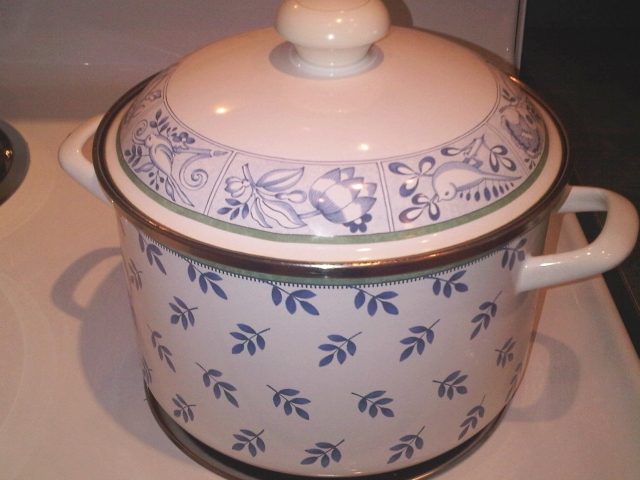
Most of my soups are cooked in a Villeroy Boch enameled soup pot that I purchased many years ago, on sale at Marshall Field’s. It was at their “after Christmas sale” at the Oak Brook store near my house in Chicago. I was with my friend T. She should have been a professional personal shopper. She can find you absolutely anything you want at the price you want to pay. So of course she was at the “90% OFF After Xmas Sale.” I’m sure she also had coupons for an additional percentage off. I remember holding a bag with the Xmas ornaments she already found when I saw them; the last two Villeroy Boch soup pots high up on a shelf in “Market Place” – Marshall Field’s housewares department. Amazingly they were already on sale with an additional amount off. Expensive even on sale – but sooo worth it.

It has been a delight and pleasure to create mouth watering soups in this pot. The enamel interior resists pitting from acids in food and the heavy gauge steel heats evenly. It still looks beautiful and has served me very well over the years.

We try to make a few pots of various soups throughout the month and get single-serving containers of soup into the freezer. Then we can easily enjoy them throughout the summer.

One of my favorite soups is split pea with ham. Usually this March soup uses the heel of the Easter ham. But Easter is VERY late this year. Using one thick slice of ham or bacon you can make this same soup today. Use green or yellow split peas. Add onions, potatoes, carrots or parsnips as you like following this recipe:

In a soup pot, saute coarsely chopped onions in a bit of olive oil. Add six to eight cups of water, 1 package of split peas, diced carrots, two tablespoons of chicken soup bouillon or stock from a jar, one ham slice – cubed. If you prefer vegetarian eliminate the ham. Add freshly grated pepper, 1 tsp garlic powder and oregano (or herbs de Provence). Add one or two bay leaves. Bring to a boil, then simmer on low for two hours, covered. Your house will smell great. When the soup is nice and thick to your liking – serve and top with oyster crackers or a dollop of yogurt.

Photo A. Meshar

Today I am making beef barley soup with some leftover potroast. I sauteed chopped onion in olive oil until softened. Then I addd the leftover beef, cubed, along with the leftover gravy, potatoes, carrots and onions. Add 6 cups of water, 1/2 cup of barley, herbs de Provence (or oregano). For an added boost you could add a small can of tomato sauce, or 1 tsp of balsamic vinegar, or 1 good squeeze of lemon juice. Simmer about 2 hours. Serve.

Photo A. Meshar

As I am simmering the beef barley soup I decided I may as well make chicken soup with the leftover chicken. Into a pot add the leftover chicken, bones and all. Add any juices or gravy. Fill pot with 6 cups of water. Onion, celery, carrots, garlic, whole peppercorns or chopped cilantro are optional. I am leaving them out today as a plain broth is my goal. But I am adding additional chicken soup base. Simmer all afternoon. Remove bones. Cut up chicken and return to broth. If you like you could add matzo balls to simmer and cook for 1/2 additional hour at this point.

Or try Mark Bittman’s soup matrix to make creamy, brothy, earthy or hearty soups without a recipe.

As the day ends, cozy up to a glass of good wine, a piece of crusty artisan bread, a candle, a friend and enjoy.

Put the remaining soup in canning jars. Take a jar to a neighbor, a friend or anyone who would appreciate a special delivery of homemade soup. Keep chilled until heated for eating. Will keep 2-3 days in the refrigerator.

Ahhh . . . the soups of March . . .

You may also like Winter Comfort Food, Spend Less On Groceries – Eat Better and What Do You Do With Your Leftovers?

Non-Profit Economy

Photo MarieClaire.com

Not too long ago our economy was primarily agricultural. Then we moved to an industrial economy. In the early part of the last century we became a manufacturing economy creating consumer goods. Within the past thirty years we have moved to a service economy to support selling consumer goods and services. Most of these goods are now manufactured elsewhere on the globe. Within the past decade, many of the services were moved off-shore as well. The advent of the Great Depression/Recession in 2008 demonstrated that service jobs will not provide the economic engine we need to move our economy forward.

Our economy is stuck. We need a new vision. A new idea about what will use our talents and resources to fulfill a need. Our biggest resource is people and their talents. The world’s biggest need is to solve poverty. Two thirds of the world’s people live in extreme poverty.

So how will we marry our resources with our world’s need to eliminate poverty?  Non-profit organizations have been doing this for a long time. Perhaps it is time for the U.S. to move to a non-profit economy.

This would focus the talents we have on those who need it most, while providing employment. Just as we have seen growth in environmental businesses we are beginning to see interest and growth in the work of non-profits. Witness the meteoric rise of micro-ending as an example of this. This is not about charity. Charity cares for the symptoms of poverty without removing the causes.

The problem of poverty is complex. Poverty can be situational, generational as well as systemic. So a real increase in our efforts to solve the causes of poverty would require many creative, effective solutions. Effective solutions involve careful listening to those who are struggling as well as creativity and imagination.

An example are the ESPERA Funds or community lending funds of Mary’s Pence, the women’s group receiving an ESPERA fund determines what interest rate works for them and decisions are made locally for loans within the fund. Ideally they will use the funds repaid to begin another ESPERA Fund. In other words the fund is not only sustainable, it has the possibility of being paid forward. “Local solutions” for “long-term change” work best.

I think it’s a pretty powerful idea and one that will move us forward – as a nation and as a global family.

Yoga, Sexuality and Integrity

Photo A. Meshar

My Yoga study continues to reveal some underlying similarities between Christianity and Yoga. Which isn’t surprising since neither tradition emerged in a vacuum. They influenced and impacted each other over thousands of years.

Traditionally, in the Eight-limbed Path of Ashtanga or Raja (Royal) Yoga there are five yamas or abstentions and five niyamas or observances. These could be understood as life directives like the Ten Commandments. One of the yamas or abstentions is brahmacharya. The word brahmacharya is made up of two words: Brahma, the absolute, eternal, supreme God-head and charya, which means “to follow” meaning follow a “virtuous” way of life.

In the tradition of Yoga, brahmacharya refers to sexual abstinence or celibacy. Like the monastic traditions of Christianity, celibacy is practiced as a way of harnessing energy from the relationships of one’s sexual life and diverting it toward deepening one’s spiritual life. In the Yoga this was traditionally taught and practiced only with regard to men.

However, if we understand sexuality as a part of our wholeness as human persons we can begin to interpret this yama of brahmacharya more expansively. If God is present within each person, then gnostic dualism (anti-body or spirit is better) is death-dealing. God within each of us means that God hears what we hear, feels what we feel and suffers what we suffer. We meet God in and through our bodies, including our sexuality. God experiences the world through our bodies. To know this is to value ourselves and our relationships with others. It is to be honest and truthful about the role sexuality plays in our lives.

The same energy that brings sexuality enlivens our spiritual life as well. Learning to become open and intimate with another also prepares us for opening ourselves to life, reality or God. Using our sexual desires in a way that is life-giving for us and for others honors our value as persons. This means that we must be willing to take the time and care required to go more deeply into a relationship with someone else. This takes effort, time and commitment. It takes monogamy. It is impossible to have the time or energy to maintain deep, committed, thus honest sexual relationships with more than one person at a time.

It also requires developing good boundaries. We develop enough self-understanding to know our own values and choose actions that respect those values. We have the ability to consistently choose those actions and responses that will keep us in a calm and abiding place. We learn to do this within the context of our own sexual relationships and within other relationships too. Simultaneously we respect others’ boundaries.

Brahmacharya in my own life means honoring my own sexuality. For me, this means choosing to be in a marriage because the relationship is life-giving and brings out the best of who I am. Earlier in my life I understood the vow of marriage (“until death do us part”) to mean staying in a marriage no matter what – even if it was abusive or soul-killing. I thought that breaking the vow meant breaking with one’s personal integrity. But gradually, I came to see that this vow is made by two parties and therefore must be honored by both parties. One person can’t honor the vow alone. When the other party is no longer committed to the vow, or was never committed, then the contract is broken.

Regardless, to remain in sexual relationships that hurt, abuse or cause sadness is to dishonor not only ourselves but others as well. This is a profound distortion of what sexuality is meant to be in our lives. We are all interconnected. Brahmacharya dictates that we seek sexuality in relationships that leave us feeling loved, valued and cared for.

You may also like Spring Cleaning – Saucha, Yoga Wisdom, Do You Need a High Approval Rating? and Salut! To Your Health!.