What is White Privilege?

Ever wonder what Native Americans think about the Fourth of July? It is a reminder of genocide from their point of view. Who were the savages?

Europeans came and took what did not belong to them. As someone of European descent, I continue to benefit from this today.

White privilege refers to benefits that I receive that I do not earn. I receive them by virtue of my skin color. To get a better understanding of how I benefit everyday day of my life from having the skin color I do (“white”) read Peggy McIntosh’s famous essay on white privilege: “Unpacking the Invisible Knapsack“.

My advantages are not “blessings” – they are unearned benefits of belonging to a particular class and skin color. I did not pull myself up by my bootstraps. Rather our “bootstraps” are unearned benefits inherited from prior generations. For example:

  • If both your parents spoke English add one inch to your bootstraps.
  • If you didn’t need to worry about when you would eat next, add one inch to your bootstraps.
  • If your parents were college educated add one inch to your bootstraps.
  • If no one in your household had a serious medical illness add one inch to your bootstraps.
  • If you didn’t move frequently in order for your parents to work add one inch to your bootstraps.
  • If you had access to good nutrition and good medical care growing up, add one inch to your bootstraps.
  • If your parents were of a class, religion or skin color that allowed them to buy property or own a home, add one inch to your bootstraps.
  • If your family could leverage that home or property to pay for college education, low interest home equity loans or to start a business, add one inch to your bootstraps.
  • If you grew up in a neighborhood without violence add one inch to your bootstraps.

Not everyone is given the same bootstraps. Our bootstraps (our abilities, skills and benefits) are the result of privileges given to some, but not to others.

Benefiting from a system that favors some over others is NOT “pulling ourselves up by our bootstraps.” We need to start speaking truthfully and seeing reality as it really is.

Now that you know, what will you do?

Recognizing the systemic nature of discrimination isn’t about working for rights for blacks, Hispanics or women, etc. It is about changing laws and practices so that we have the same human rights for everyone.

Learn more.

Listen to Michelle Alexander on YouTube or read her book The New Jim Crow to learn how our nation’s prison system has become another racial caste system in use in our country today.

You may also like Myth of Objective Reporting, White Privilege, Poverty is a Luxury We Can NOT Afford and Truth or Consequences.


Romantic Porch Inspiration

We have a room that needs some TLC. However, like every room in our home, this room has many functions. It is mainly an office for DH. Occasionally it serves as a quiet reading room. Now I would like it to function as a front porch as well.

Here are some inspiration pictures of light, bright work spaces.

Photo OfficeDecordir.com
Photo OfficeBlog.Americanchic.net
Photo OfficeEhomee.com
Photo OfficeFopple.com
Photo OfficeHousedesignet.com

These pictures are useful because they are in small spaces, using a lot of white with some shots of color for interest. For the most part they can all accomodate more than one function in the room. Lastly, they are casual so could easily blend with a summery or “porch” feel.

Photo CountryLiving.com

Do you have a porch? Porches remind me of summer. I like the idea of a space where you can wind down at the end of the day.

I also like the idea of a space that connects us to our neighborhood and the world outside our doors.

It’s also nice to have a quiet, easy spot away from the main area of the house.

:Photo SouthernLiving.com
Photo Lowes.com

So, how to have a space like that in our house? We don’t have front porch – but we do have a small room with a large window that faces the front of our house. It also faces east, so cooler at the end of the day. Hmmm. . .

You may also like Picnic in a Jar, Citron Pressé, and Easy Summer Travel Wardrobe.

Why We Should Listen

Two thirds of the world’s population live on $2 per day or less. The world’s poor are mainly women and children. Capitalism alone can’t solve global poverty. This is because capitalism can’t provide equal access to resources and markets.

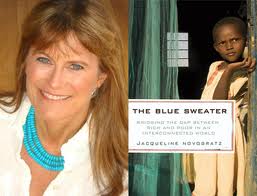
So what can we do? We can listen and learn from local people with local wisdom. Like Mary’s Pence ESPERA Funds, Jacqueline Novogratz – a previous financial executive – has a better idea about what we can do. Listen to her here on TED Talks.

She has a number of TED talks dating from 2006. Most are 10 minutes or less and worth listening to.

“Why you should listen to her:

One of the most innovative players shaping philanthropy today, Jacqueline Novogratz is redefining the way problems of poverty can be solved around the world. Drawing on her past experience in banking, microfinance and traditional philanthropy, Novogratz has become a leading proponent for financing entrepreneurs and enterprises that can bring affordable clean water, housing and healthcare to poor people so that they no longer have to depend on the disappointing results and lack of accountability seen in traditional charity and old-fashioned aid.

The Acumen Fund, which she founded in 2001, has an ambitious plan: to create a blueprint for alleviating poverty using market-oriented approaches. Indeed, Acumen has more in common with a venture capital fund than a typical nonprofit. Rather than handing out grants, Acumen invests in fledgling companies and organizations that bring critical — often life-altering — products and services to the world’s poor. Like VCs, Acumen offers not just money, but also infrastructure and management expertise. From drip-irrigation systems in India to malaria-preventing bed nets in Tanzania to a low-cost mortgage program in Pakistan, Acumen’s portfolio offers important case studies for entrepreneurial efforts aimed at the vastly underserved market of those making less than $4/day.

It’s a fascinating model that’s shaken up philanthropy and investment communities alike. Acumen Fund manages more than $20 million in investments aimed at serving the poor. And most of their projects deliver stunning, inspiring results. Their success can be traced back to Novogratz herself, who possesses that rarest combination of business savvy and cultural sensitivity. In addition to seeking out sound business models, she places great importance on identifying solutions from within communities rather than imposing them from the outside. ‘People don’t want handouts,’ Novogratz said at TEDGlobal 2005. ‘They want to make their own decisions, to solve their own problems.’

In her book, The Blue Sweater, she tells stories from the new philanthropy, which emphasizes sustainable bottom-up solutions over traditional top-down aid.” – TED Talks.

You may also like Does Everyone Have a Voice? and What Can You and I Do?

Greeks Resist Public Bank Bailout

Timothy Garton Ash spells out what is at the core of the violence we are seeing in Greece, Ireland and other European countries. Again, language plays a role here. “Public bank bailout” is almost NEVER referred to on CNN or mainstream media. Rather it is described as “austerity measures.” Published today at ekathimierini.com, “The end of Europe as we know it” by Petros Papaconstantinou:

For his part, Timothy Garton Ash wrote in the Guardian on June 15: “It’s not just Greece. In Ireland, Portugal and Spain the anger is boiling over, as people feel that the young, the poor and the unemployed are being forced to pay for the selfish improvidence of their politicians — and of French and German bankers.”

Bold emphasis is mine. The same is true for us here in the U.S., since our banks actually started this financial crisis – now rippling through the global economy.

NET – Pushing bank losses from unethical sub prime mortgage loans and investments onto the public should not be tolerated by people anywhere. Why are we tolerating it here in the U.S.? Because, unlike Greece, we haven’t experienced, or don’t understand, the costs of paying for it . . . yet.

You may also like Budget Policy Choices, Truth or Consequences, On Osama bin Laden’s Death and Power of Framing.

Solving the Problem of Poverty

ESPERA Funds: A Better Idea for Solving the Problem of Poverty

Edica is a young mother in El Salvador barely making ends meet. She struggles daily to care for her children, feed them and send them to school. There are no jobs available in her village. She is determined and resourceful but, as in many countries, banks do not lend to women. What can she do? What would you do?

Micro-lending might be an option but that can be dangerous. You may have read about the recent problems uncovered in the micro-lending industry. Often the money actually goes to another lending institution, rather then to the individual pictured on the website. Or the interest charged might quickly become more than the value of the loan. Sometimes a woman applies for a loan that actually ends up in the hands of others – usually men – although the woman is legally responsible for the loan. These abuses hurt every organization working to end poverty through sustainable change.

After almost 25 years of granting and working with women in the Americas, Mary’s Pence, a faith based non-profit, decided there had to be a better way to help end the cycle of poverty. I know. As a board member of Mary’s Pence I watched and participated as month after month the women of Mary’s Pence collaborated to create a sustainable and local alternative. After months of strategic planning and collaboration ESPERA Funds were born.

Mary’s Pence ESPERA Funds (“she hopes” in Spanish) go to networks of women – not individuals. Together, using the power of community, women can share ideas. Each network is made up of a group of women who encourage and support each other in starting sustainable businesses right in their own communities.

ESPERA Funds are designed so decisions are made by local women creating local solutions. The women in the network are in the best place to determine which projects should be funded and the interest they need to charge for their lending pool (ESPERA Fund). Loans are repaid to the community fund so more new businesses can be started or the money can be loaned to another network. Successful projects are grounded in the community and serve the needs of the local village.

ESPERA Funds recently completed its first year. There are now four funds working in communities in Central America and Mexico. The results are exciting. When women do better children benefit, families are more secure and the entire community does better. With a reliable income Edica and women like her, can send their children to school instead of to work. For Edica, a sustainable income means that she can plan and save for her future.

Mary’s Pence ESPERA Funds are supported by donations from individual donors. There is no endowment fund or large grant to support this work. Mary’s Pence relies on social outreach, churches, women’s groups, faith groups and those they know to spread the word.

What can you do? Join me. Be part of the poverty solution. Consider learning more at www.maryspence.org, sign up for Mary’s Pence E-Newsletter, or make a donation. Become a Companeras by donating automatically each month. Better yet, volunteer to host a giving circle at your next book club or gathering – even dollars or change on hand makes a good donation.

Make a difference today. Just click funding women, changing lives.

In Africa women are doing similar work. Watch Jacqueline Novogratz, founder of Acumen Funds, describe investing in local solutions and the power of patient capital.

You may also like Poverty is a Luxury We Can NOT Afford, What Can You and I Do?, Does Everyone Have a Voice? and Kowalski’s Grocery Store and Fiji Water.