 With wheat prices spiralling out of control and food costs going up – we decided to get more creative about eating, and eating well.
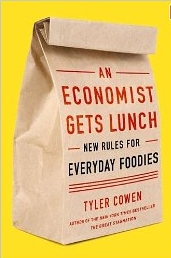
I thought that Tyler Cowen’s new book An Economist Gets Lunch: new Rules for Everyday Foodies (Dutton: 2012) might help with that. For example, he suggests using Asian groceries for a more inexpensive, wider selection of greens (Hmmm, there’s a Vietnamese grocery just around the corner . . .).
However, many of his suggestions were tired; when traveling we already know to ask the locals where they eat, for example. Likewise we know to check ethnic restaurants in neighborhood strip malls away from pricey downtown areas.
Nevertheless, his idea to turn any Chinese restaurant in this country into an excellent Chinese restaurant was a good one; ask to speak to the chef and requesting what he would make for himself with tofu.
But on other fronts, I wondered how much was he paid by big agribusiness and the genetically modified food industry to wax on about how wonderful these industries are? The reality that economists are funded in academia by big agribusiness seems especially obvious here. Plus he ends up refuting his own glossy account of agribusiness by explaining at length, later in the book, how much better Mexican beef is because it’s grass fed, or how much better the tortillas are, handmade using local corn, etc. So Tyler which is it? Is big agribusiness creating better food or not?
Toward the end of the book he lost me when his section on France failed to highlight the fabulous street food (can you say golden mushroom crepes anyone?) and fresh fruits/vegies available at any Parisienne neighborhood, morning market – not to mention the delicious and inexpensive table wines at even the local Monoprix. Made me wonder, was he actually in France?
This led me to question overall what he writes about hunger, food distribution and the food industry. He may be an economist, but he’s a privileged, American, white male who doesn’t know much about the complex problem of hunger, countries made poor (by rich ones) or multi-national corporate interests when it comes to food.